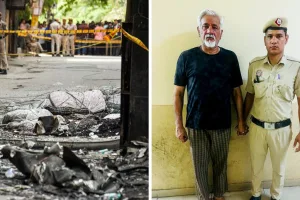
On the night of 28 May 2010, India witnessed one of the darkest acts of Maoist violence in its modern history. At around 1.30 AM, the Jnaneswari Express travelling through West Midnapore in West Bengal was derailed after suspected Maoist saboteurs tampered with railway tracks between Khemasuli and Sardiha stations. Moments later, an oncoming goods train rammed into the derailed coaches. The carnage was horrific.
At least 148 innocent passengers were killed and more than 200 injured. Entire families were shattered in a matter of seconds. Mangle d train compartments, bodies strewn across tracks, and desperate cries for help became haunting images etched into the nation’s memory. Sixteen years later, the Jnaneswari Express tragedy remains far more than a railway disaster. It stands as a grim symbol of a period when India’s response to Left-Wing Extremism was marked by hesitation, ideological confusion, and strategic drift.
Advertisement
The decade of the UPA government between 2004 and 2014 saw the Naxal movement expand dangerously across large parts of India, even as New Delhi often appeared uncertain about how to confront it. The consequences of that uncertainty were devastating. From the mid-2000s, Naxalism was no longer a localized insurgency confined to remote pockets. It had evolved into a deeply entrenched armed movement operating across what came to be known as the “Red Corridor” – stretching through Chhattisgarh, Jharkhand, Odisha, Maharashtra, Andhra Pradesh and parts of West Bengal. In many tribal regions, Maoists had effectively established parallel authority structures.
“Jan adalats” dispensed brutal kangaroo justice. Contractors, traders, mining operators and even poor villagers were forced to pay levies. Schools were destroyed because Maoists viewed education infrastructure as symbols of state penetration. Roads were blown up repeatedly to isolate villages and obstruct security movement. Young tribal boys and girls were indoctrinated and recruited into armed squads. The writ of the Indian state weakened in several interior districts. Yet, much of the political discourse in Delhi during those years remained trapped in intellectual ambiguity.
A powerful section within the ruling establishment insisted on viewing Naxalism primarily through the prism of poverty, underdevelopment and tribal alienation. Certainly, these socio-economic realities existed and demanded urgent redressal. But reducing Maoist violence merely to a developmental issue often led to dangerous moral equivalence between the democratic state and an armed insurgency openly committed to overthrowing constitutional order. That distinction mattered. For ordinary villagers living in Bastar or Lalgarh, this was not an abstract academic debate about “root causes.”
It was a daily struggle for survival. Schoolteachers were executed as alleged police informers. Panchayat representatives were assassinated. Villagers refusing to cooperate with Maoists were publicly punished. Entire communities lived in fear of both the gun and the uncertainty surrounding state response. Security personnel operating in dense forest terrain frequently felt they were fighting a war without clear political backing. The lack of strategic clarity at the top emboldened the Maoist leadership.
They sensed divisions within the political and intellectual establishment and exploited them ruthlessly. The result was a series of increasingly audacious attacks. In April 2010, just weeks before the Jnaneswari tragedy, 76 CRPF personnel were massacred in Dantewada. The Balimela ambush in Odisha had already exposed the growing operational sophistication of Maoist groups. Later came the horrific Jhiram Ghati attack in 2013, where senior political leaders were targeted and killed in Chhattisgarh. These were not isolated incidents. They reflected a steadily escalating insurgency that had gained confidence during years of inconsistent policy response.
The Jnaneswari Express attack was particularly significant because it demonstrated that Maoist violence could strike far beyond forested conflict zones. The derailment occurred in Jungle Mahal, an area where Maoist influence had grown rapidly amid political instability and weak governance. The targeting of a civilian train revealed the sheer disregard Maoists had for innocent human life despite their claims of fighting for the marginalized. Yet even after such incidents, the national response often oscillated between limited security action and renewed calls for dialogue.
This inconsistency created operational breathing space for insurgent groups. One of the most misunderstood chapters of that era was the emergence of Salwa Judum in Chhattisgarh. To portray Salwa Judum merely as a “state-sponsored militia,” as much of the urban commentary did at the time, is to ignore the desperation that gave birth to it. For many tribal communities in Bastar, Salwa Judum represented a spontaneous expression of resistance against Maoist intimidation. Villagers wanted schools to function, roads to be built, markets to reopen, and their children to grow up outside the shadow of armed extremism.
Led prominently by Mahendra Karma, the movement reflected the frustration of ordinary Adivasis who felt abandoned between Maoist coercion and state incapacity. This does not mean that excesses did not occur. They did, and they deserved scrutiny. Human rights concerns could not and should not be ignored. But the broader national conversation frequently became one-sided, focusing almost exclusively on alleged state excesses while underplaying the systematic brutality unleashed by Maoists on tribal populations themselves. That imbalance had consequences. The Supreme Court’s 2011 ruling against the Special Police Officer system weakened local anti-Maoist resistance structures considerably.
Many villagers who had openly opposed Maoists suddenly found themselves vulnerable again. When Mahendra Karma was assassinated in the Darbha Valley attack in 2013, it was not merely the killing of a political leader. It was a symbolic elimination of one of the strongest tribal voices challenging Maoist domination. Looking back, the UPA years can justifiably be described as a “Decade of Drift” in India’s battle against Left-Wing Extremism. The central failure was not simply tactical. It was intellectual and political. India struggled to define the conflict clearly.
Was Maoism merely a manifestation of socio-economic deprivation? Or was it a violent ideological movement seeking to dismantle democratic institutions through armed revolution? The inability to answer that question decisively delayed coherent national strategy. Fortunately, the years that followed saw a more integrated and determined approach emerge. Counter-insurgency operations became sharper and more coordinated. Simultaneously, roads, mobile connectivity, banking access, welfare delivery and tribal outreach improved significantly in many previously inaccessible regions. The lesson gradually became clear: security and development are not competing approaches — they must move together.
Today, Maoist influence has receded substantially across several former strongholds. That progress has come at enormous cost — paid by security personnel, tribal civilians, political workers and ordinary citizens caught in the crossfire. As India marks the 16th anniversary of the Jnaneswari Express tragedy, remembrance alone is not enough. The country must also remember the policy failures that allowed the crisis to deepen during that era. Internal security threats cannot be confronted through ambiguity.
Democracies can and must address poverty, injustice and underdevelopment. But no democratic state can afford confusion when faced with organized violence aimed at destroying constitutional order itself. The 148 passengers who died that night in West Midnapore were not casualties of an abstract ideological conflict. They were victims of a national failure to recognize the scale and seriousness of a growing insurgency in time. Their memory should remain a permanent reminder that when the state drifts, extremism advances.
(The writer is a national spokesperson of BJP and an acclaimed author.)